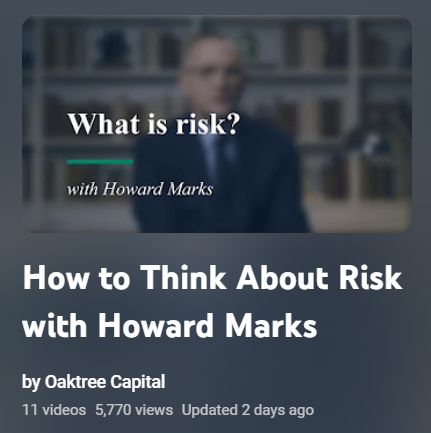
두고두고 곱씹어야 할 하워드 막스의 리스크에 대한 생각을 담은 영상이다.
투자자가 인지하고 있어야 할 리스크, 손실 위험에 대한 개념과 차이점, 그에 대하는 자세를 어떻게 취할지 생각하게 하는 영상의 스크립트를 따보았다.
자동 스크립터를 썼더니, ㅎㅎㅎ
영 틀린 곳이 많다.
원본 영상은 아래에서
https://www.youtube.com/playlist?list=PLxbi-KAxos9tf1iHzRFTZmXDsGI-nQGsm
번역 영상은 여기서
https://www.youtube.com/watch?v=UK5pQdegVJs
보면된다.
Transcript:
(00:00) hi I'm Howard marks and this is how to think about [Music] risk the title of this class is how to think about risk that's an important title not what to think how to think the first question is what is risk risk in my opinion is the ultimate test of an Investor's skill the return alone doesn't tell you how good a job the manager did the key question is you see the return you must ask how much risk did the manager bear to get that return now let's look at this range of managers what we posit is that the market is up
(00:48) 10% or down 10% now let's look at some individual managers the first one is up 10 when the Market's up 10 and down 10 when the Market's down 10 ACC lishes nothing you might as well have invested in an index fund that emulates the performance of the market no skill no value added now let's look at the second one up 20 when the market goes up 10 down 20 when the market goes down 10 no skill no value added just a lot of aggressiveness what about this one up five when the Market's up 10 down five
(01:23) when the Market's down 10 again no selection ability no discernment no value added just defensiveness you don't need help in achieving that and you sure shouldn't pay a lot for it but what about the next one he or she is up 15 when the Market's up 10 and down 10 when the Market's down 10 so in other words Market type losses on the downside but Superior gains on the upside value added what I call asymmetry does better in the good times than does poorly in the bad times but what about this one and I
(01:56) think this is the most interest and I think maybe it characterizes Me Maybe it izes oak tree to some extent up 10 when the Market's up 10 down five when the Market's down 10 so Market type gains in the good times I personally think that performing with the market when it does well is good enough and that's almost all the time nobody should have to beat the market when it does well but if you can do that and at the same time be ready to decline less when the market has it down spells I think that's
(02:32) accomplishing something very [Music] important I believe that risk is not volatility the academics developing investment Theory largely at the University of Chicago in the early 60s just a couple of years before I got there adopted volatility as their measure of risk I believe they did so largely because volatility is readily quantifiable and nothing else is I think volatility can be an indicator of the presence of risk a symptom if you will but it's not risk itself so if risk is not volatility then what is it and in my
(03:17) opinion and in the real world sense risk is the probability of loss I think this is what most people mean when they say risk and I think that this is what people demand compensation for if they're going to Bear it uh nobody sitting around at Oak Tree says well you know uh we shouldn't make that investment because it might be volatile or uh because it might be volatile we should demand a higher return no they say that about the possibility of loss we're not going to make that investment because the possibility of loss is too
(03:51) high or because of the possibility of loss we're going to demand a risk premium in terms of the return this is risk the possibility of loss now another important question is is risk quantifiable in advance and I believe it's not like most things occurring in the future risk cannot be anything except a matter of opinion I was writing my first memo about risk in 2006 I wrote about my belief that risk is not quantifiable in advance and then I hit the return key and went on to the next section and wrote something I had never
(04:29) thought about before my belief that risk is unquantifiable even after the fact and I think this is a fascinating topic uh you buy something for a dollar and a year later you sell it for $2 was it risky and the interesting thing is that you can't tell from the outcome a profitable investment may or may not have been risky was it a safe investment that in the case of my example was sure to double or was it a risky investment where you got lucky in terms of the outcome and as I say you can't tell from the outcome the bottom line is to me
(05:11) it's impossible to quantify risk in advance or even in hindsight the possibility of loss is not the only form of risk there are lots of forms of risk my last memo on the general subject it's called risk Revisited again and I talk in there about 24 or 25 different forms of risk some serious some factious some important some less important and obscure but still it comes in many forms the risk of missing opportunities is another important risk in other words if you think about it the risk of not taking enough risk another really
(05:54) important form uh of risk I think one of the key risks in investing is the chance of being forced out at the bottom which is a bigger mistake buying at the high and seeing a decline or selling out at the low and missing out on the recovery clearly it's the ladder if you buy at a high and you experience a decline if you're able to hold throughout and not lose your nerve the next high is usually higher than the last High the fact that you experienced a downward fluctuation might have been uncomfortable for a
(06:29) little while but by the time the new high is achieved you're you're you're back to to your cost and more but if you sell at the bottom and miss out on the subsequent recovery that means you've gotten off the track of investing and uh may never get back on in my opinion selling at the bottom it's the cardinal sin in investing [Music] now I want to get a little philosophical one of my great Heroes Peter Bernstein probably the best thinker in a philosophic sense and and a real investment Sage who sadly passed away
(07:12) around 2009 one said essentially risk says we don't know what's going to happen we walk every moment into the unknown he said there's a range of outcomes and we don't know where the actual outcome is going to fall within the range and often we don't know what the range is so in other words we have ignorance to varying degrees about what the future holds and it is from this ignorance uh that risk ensues if we knew what was going to happen by definition there would be no risk in the memo that
(07:48) I mentioned before risk Revisited again there's a great quote uh that I got from a Peter Bernstein memo and I thought it was so important that I took it over word for word in my memo it's from GK Chesterton who was a English uh writer and he said the following and I'm going to give it to you word for word uh because it's so important the real trouble with this world of ours is not that it is an unreasonable world or even that it is a reasonable one the commonest kind of trouble is that it is
(08:26) nearly reasonable but not quite life is not an illogicality yet it is a trap for logicians it looks just a little more mathematical and regular than it is its exactitude is obvious but its inexactitude is hidden its wildness lies in weight in other words we know what's likely to happen we know the other things that probably could happen instead we have little appreciation for the things that are highly unlikely to happen but could and these are what we call in modern day terms the uh tail events my friend Rick kanaine once said
(09:14) that 96% of financial history has occurred within two standard deviations but everything interesting has happened outside of two standard deviations that's the wild part [Music] so now let me try in a slightly philosophical sense to reflect to you how I think about risk how I think you might consider risk through four basic points number one there was a professor at the London Business School who said risk means more things can happen then will happen for most events that lie in the future there are a number of things
(10:01) that could occur we don't know which one it will be that's where the risk comes in more things can happen then will happen number two as a result of that the future should be viewed not as a fixed outcome that's destined to happen and capable of being predicted but as a range of possibilities and hopefully because you have some insight into their respective likelihoods as a probability distribution the most likely the less likely the unlikely but not impossible number three it's important to accept
(10:37) that even when you know the probabilities that doesn't mean you know what's going to happen uh this is uh something that I think many people fail to grasp I play a lot of back gamon and a lot of my examples uh on risk and uncertainty...