스탠리 드러켄밀러의 블룸버그 인터뷰: Fed Policy, Election, Bonds, Nvidia (24.10.17)

돌연변이
2024.10.17조회수 29회
돌연변이
구독자 344명구독중 76명
지혜로운 사람이 되고 싶습니다.
"I may be paranoid, but not an android"
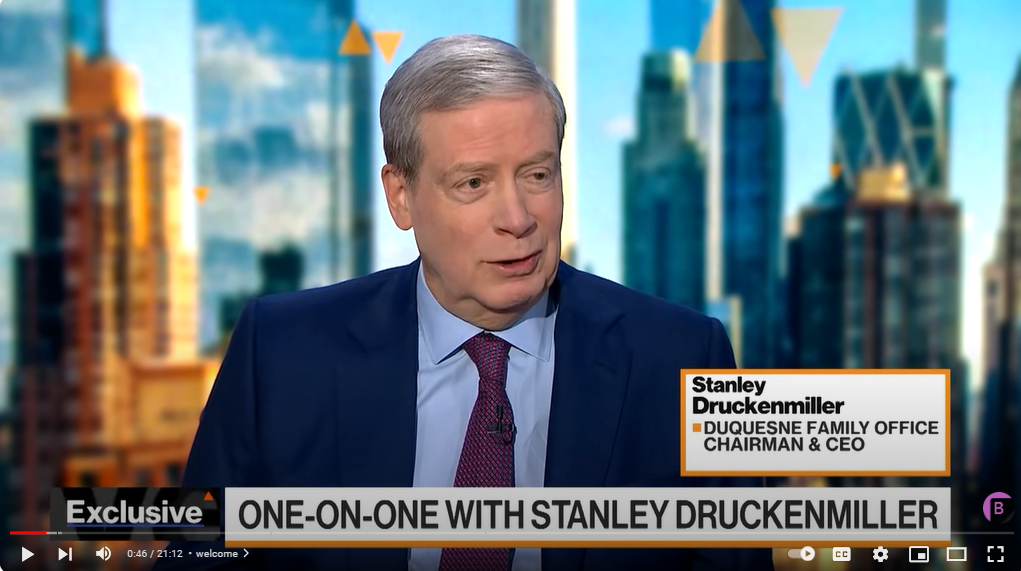
인터뷰영상: https://youtu.be/-4NuOAfZjHo?si=nNj8bFQ1OoN-U-uy
ChatGPT로 번역했습니다.
사회자:
I want to welcome our Bloomberg Television and radio audiences to this special episode of Bloomberg Markets. We are here with an exclusive interview with the chair and CEO of Duquesne Family Office, billionaire investor Stanley Druckenmiller.
Now, Stan, in 2021, you wrote an opinion piece in The Wall Street Journal stating that the Fed was playing with fire. A couple of weeks ago, you wrote to me, expressing your hope that the Fed would not make the same mistake it made in 2021—the mistake of being trapped by forward guidance.
What's at stake here? Why are you so concerned?
블룸버그 텔레비전과 라디오 청취자 여러분, 블룸버그 마켓의 특별 에피소드에 오신 것을 환영합니다. 오늘은 두케인 패밀리 오피스의 회장이자 CEO인 억만장자 투자자 스탠리 드러켄밀러와의 독점 인터뷰를 진행합니다.
자, 스탠. 2021년에 당신은 연준이 불장난을 하고 있다고 월스트리트 저널에 의견 기고문을 썼죠. 몇 주 전에 당신은 저에게 연준이 2021년에 했던 같은 실수를 반복하지 않기를 바란다고 말씀하셨습니다. 그 실수는 바로 정책 방향 예고(선제 안내)에 갇힌 것이었습니다.
여기서 무엇이 위험한가요? 왜 그렇게 우려하시는 건가요?
스탠리드러켄밀러:
Thanks, Sonali. It's nice to be here.
In 2021, I think the Fed did a great job when we were facing a black hole during COVID in 2020. They took some very aggressive actions. One of those actions was forward guidance to try and stabilize the markets, essentially moving towards a zero interest rate policy.
고마워요, 소날리. 여기 오게 되어 기쁩니다.
2021년에, 저는 연준이 2020년 COVID로 인한 위기 상황에서 훌륭한 일을 했다고 생각합니다. 그들은 매우 공격적인 조치를 취했습니다. 그 조치 중 하나는 시장을 안정시키기 위한 선제 안내였으며, 사실상 제로 금리 정책으로 나아간 것이었습니다.
스탠리드러켄밀러:
I think that, frankly, we were all misled by COVID for about three years.
I was, too, when it first happened. We wondered, “Are we sinking into a black hole?”
But it became pretty obvious, maybe a month or two after the vaccine was confirmed in the fall of 2020, that we weren’t headed into a black hole.
Unemployment, which had been around 14%, started to drop significantly. The economy bounced back.
We wrote the article in the spring of 2021 because, by then, it felt like the economy was booming. It was everywhere—the economy, the companies we spoke to, and the unemployment rate—all signs pointed to a strong recovery. But the Fed wasn’t adjusting.
They were still buying, I think, around $120 billion a month in securities, which may have reduced to about $95 billion by that time, and rates were still at zero.
I believe that if they’d had a clean slate, they would have never been buying bonds to that extent given the economic conditions. But, in my opinion, they were trapped by forward guidance.
솔직히 말해서, 우리는 모두 COVID로 인해 약 3년 동안 잘못된 판단을 했다고 생각합니다.
저 역시 마찬가지였고, 처음에 이 일이 발생했을 때 우리는 “우리가 블랙홀에 빠지고 있는 것일까?”라고 궁금해했습니다.
하지만 2020년 가을에 백신이 확인된 지 한두 달 후쯤에는 우리가 블랙홀로 향하고 있지 않다는 것이 꽤 명백해졌습니다.
실업률은 약 14%였는데, 급격히 하락하기 시작했고 경제는 회복되었습니다.
우리는 2021년 봄에 그 기사를 썼습니다. 그때쯤에는 경제가 활황을 띠고 있다는 느낌을 받았기 때문입니다. 경제와 우리가 이야기했던 기업들, 실업률까지 모든 곳에서 강력한 회복의 신호가 보였습니다. 하지만 연준은 조정하지 않았습니다.
그들은 여전히 월 약 1,200억 달러의 증권을 매입하고 있었고, 그때쯤에는 약 950억 달러로 줄었을 수도 있지만 금리는 여전히 제로였습니다. 제 생각에는, 만약 그들이 처음부터 다시 시작할 수 있었다면, 당시 경제 상황을 고려해 그 정도로 많은 채권을 매입하지는 않았을 것입니다. 하지만 제 판단으로는, 그들은 선제 안내에 묶여 있었습니다.
It’s pretty incredible that we had to write the article because it was so obvious.
It took 13 months from when inflation passed 2% for them to finally raise rates.
During that time, they also bought $2 trillion worth of bonds. The reason I draw this analogy to today, although it’s quite different, is because back then I was very confident that they were wrong about inflation. The money supply was growing at 40%.
As I mentioned, the economy was booming. But this time, things are more nuanced.
However, I’m just looking at the asymmetry here.
Back then, inflation surpassed the target, reached 8.5%, and continued for three more months while they kept rates at zero and bought bonds like crazy.
And when they finally made a move, they raised rates by only 25 basis points, justifying it by saying they needed to "see the whites of inflation's eyes," even when inflation was already at 3%, 4%, or even 5%.
Okay, Today, we’re still quite a bit above the target, with measurements showing somewhere between 2.5% and 3.25%, depending on the metric used.
그때 상황이 너무 명백했기 때문에 우리가 그 기사를 써야 했다는 것이 믿기지 않을 정도입니다.
인플레이션이 2%를 넘은 후, 금리를 올리기까지 13개월이 걸렸습니다.
그 기간 동안 연준은 2조 달러의 채권도 매입했습니다. 제가 오늘날과 그때를 비교하는 이유는, 그때는 연준이 인플레이션에 대해 잘못 판단하고 있다는 확신이 있었기 때문입니다. 통화 공급은 40% 증가하고 있었죠.
앞서 말했듯이, 당시 경제는 활황이었습니다. 하지만 이번 상황은 훨씬 미묘합니다.
다만, 저는 이 비대칭성을 보고 있습니다. 그때는 인플레이션이 목표를 넘어 8.5%까지 올라갔고, 3개월 더 지속되었지만, 그들은 여전히 금리를 제로로 유지하고 채권을 마구 사들였습니다. 그리고 마침내 그들이 움직였을 때, 금리를 25bp만 인상했습니다. 그리고 그들의 근거는 "인플레이션의 ‘흰자’를 봐야 한다(인플레이션 위협이 눈앞에 확실히 드러날 때 까지 기다린다)"는 것이었는데, 그때 인플레이션은 이미 3%, 4%, 심지어 5%에 이르고 있었습니다. 오늘날 우리는 여전히 목표치보다 꽤 높은 수준에 있으며, 측정 방식에 따라 2.5%에서 3.25% 사이로 나타납니다.
스탠리드러켄밀러:
They’ve come up with this, I guess, theory that monetary policy is restrictive due to real inflation rates. But I don’t really go by theory.
I’m a market-driven person. Frankly, over the years, we’ve found that markets are better predictors than professors.
When I look around, equities are at record highs, gold is at a record high, GDP is above trend, and bank earnings and forecasts look solid. We’re not seeing any signs of restriction.
Crypto is going crazy—you name it. So, suddenly, the same group that insisted on "seeing the whites of inflation's eyes" and being data-dependent rather than forward-looking is now cutting rates by 50 basis points, not the quarter they started with, and we haven’t even hit the target yet.
And this is all based on the theory that monetary policy is restrictive. What I’d say is this: I don’t have the same conviction I did in 2021, when we wrote that article, that the Fed is going to be wrong. But from a risk-reward perspective, it just doesn’t make sense to me at all to lay out the cards they have and commit to forward guidance again.
What I was trying to say by comparing it to 2021 is that I just hope, if the data doesn’t support them—and it hasn’t so far since they started this narrative—they adjust this time and don’t get trapped by forward guidance as they did in 2021.
그들은 실제 인플레이션율 때문에 통화 정책이 긴축적이라는 이론을 내놓았습니다. 하지만 저는 이론에 의존하지 않습니다.
저는 시장에 기반을 둔 사람입니다. 솔직히 말해서, 우리는 수년간 시장이 교수들보다 더 나은 예측자라는 것을 알게 되었습니다.
주위를 둘러보면, 주식은 사상 최고치를 기록하고 있고, 금은 사상 최고치에 있으며, GDP는 추세를 웃돌고 있고, 은행 수익과 전망도 견고해 보입니다. 우리는 어떤 긴축의 징후도 보이지 않습니다.
암호화폐도 크게 상승하고 있습니다—말하자면 시장 전반이 그렇습니다. 그런데도, 인플레이션이 뚜렷하게 나타날 때까지 기다리겠다며 데이터에 의존하겠다고 했던 그들이 이제 50bp를 인하하고 있습니다. 처음에는 25bp로 시작했는데, 목표에도 아직 도달하지 않았죠.
이 모든 것이 통화 정책이 긴축적이라는 이론을 바탕으로 한 것입니다. 제가 말하고 싶은 것은 이겁니다: 저는 2021년에 그 기사를 쓸 때처럼 연준이 잘못 판단하고 있다고 확신하지는 않습니다. 하지만 위험과 보상의 관점에서, 그들이 이번에도 선제 안내에 얽매이는 것은 전혀 합리적이지 않다고 생각합니다.
제가 2021년과 비교한 이유는, 만약 데이터가 그들과 함께하지 않는다면—그리고 그들이 이 내러티브를 시작한 이후로 확실히 그렇지 않았습니다—이번에는 그들이 조정하고, 2021년처럼 선제 안내에 갇히지 않기를 바란다는 것이었습니다.
사회자:
Listen, does this mean that you thought 50 basis points was an absolute mistake? And do you think that there is a risk of an inflationary spike in the way we saw in the 1970s?
그러니까, 50bp 인하가 완전한 실수라고 생각하신 건가요? 그리고 1970년대에 봤던 것처럼 인플레이션 급등의 위험이 있다고 보십니까?
스탠리 드러켄밀러:
Yeah. Do you have the chart we talked about earlier?
네. 아까 이야기했던 차트가 있나요?
사회자:
Let’s see if we can pull it up. It’s certainly a chart that investors have been paying attention to.
그걸 띄워볼 수 있을까요? 이 차트는 투자자들이 주목해 온 차트입니다.
스탠리 드러켄밀러:
But even if we don’t have the chart, in the 1970s, inflation dropped from a remarkably similar level to where it was in 2021.
차트가 없더라도, 1970년대에 인플레이션이 2021년과 매우 비슷한 수준에서 내려갔었죠.
스탠리 드러켄밀러:
I think inflation peaked at 9% in 2021, and it was around 8% back in the seventies. Inflation dropped down to 3% as the Fed started easing due to the 1975 recession. The Fed began loosening policy, but inflation surged again, reaching a peak of about 12% when Volcker came in and aggressively curbed it.
I’m not predicting that will happen, but easing into a financial market melt-up, given the fiscal policies we have in place, certainly poses a risk. I think it’s a mistake not to account for that risk.
I don’t really understand the rush to cut by 50 basis points, and I think the market has already priced in a 97% chance of a rate cut at the next meeting, all due to Fed guidance.
It’s funny—my friend Jim Grant, one of my favorite writers, once said, “They’re not data-dependent; they’re forward guidance-dependent.” And that’s exactly what they’re showing again. Look, he could be right, and I hope he is, but this is a big risk because if they’re wrong and inflation surges because monetary policy isn’t actually restrictive enough, combined with ongoing fiscal expansion, they might need to tighten again. If that happens, it could spell disaster for the markets and potentially even compromise the Fed’s independence. You can’t afford to make multiple mistakes ...


영포자인 저에게는 빛 그자체인 글이네요 증말 감사합니다

덕분에 좋은 인터뷰 잘 봤습니다. 감사합니다!

감사합니다! 잘보았습니다.
와 드러켄밀러가 인터뷰를 했었네요! 감사합니다!