(팟캐스트)At Barrons: Billionaire Investor Howard Marks on Ownership vs. Debt

돌연변이
2024.11.10조회수 5회
돌연변이
구독자 345명구독중 76명
지혜로운 사람이 되고 싶습니다.
"I may be paranoid, but not an android"
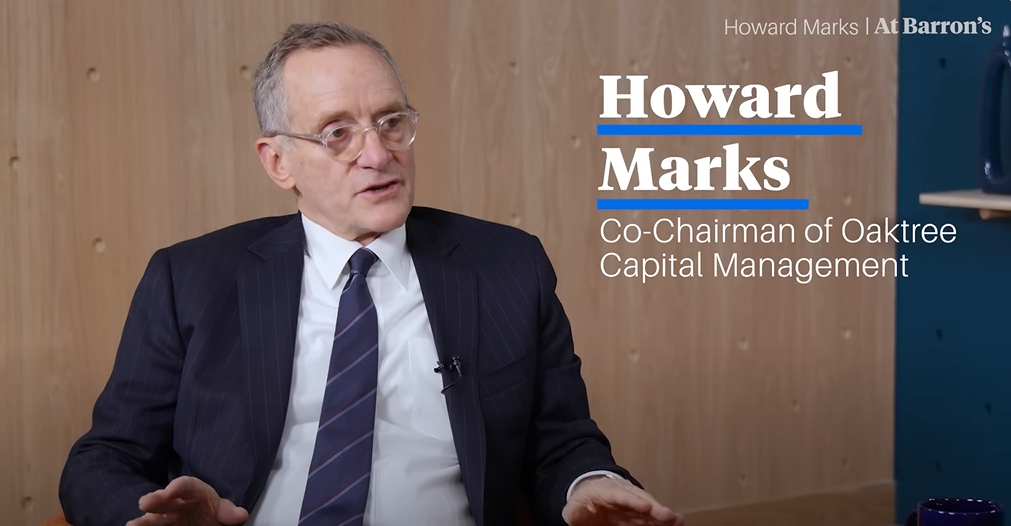
원본 유튜브 영상: https://youtu.be/u36afZDX8Jo?si=MVM2bL_CazRyZYMX
주된 내용이 하워드 막스의 메모들과 일맥상통하기 때문에, 팟캐스트 카테고리에 올리고자 합니다.
Andy Serwer:
Hello everyone and welcome to At Barron's. I'm Andy Serwer and welcome to our guest Howard Marks, co-chairman of Oaktree Capital. Howard, great to see you.
여러분 안녕하세요, At Barron's에 오신 것을 환영합니다. 저는 Andy Serwer입니다. 오늘의 게스트로 Oaktree Capital의 공동 회장이신 Howard Marks를 모셨습니다. 하워드, 만나서 반갑습니다.
Howard Marks:
Nice to see you, Andy. 반갑습니다, 앤디.
Andy Serwer:
So first of all, can you tell us a little bit about Oaktree for people who aren't familiar with the firm?
우선, Oaktree Capital에 대해 잘 모르는 분들을 위해 회사를 간단히 소개해 주시겠습니까?
Howard Marks:
Well, Oaktree is a global alternative investment manager, which basically means not mainstream stocks and bonds with its roots in credit. We're approaching 30 years old and we're around $200 billion under management.
Oaktree Capital는 글로벌 대체 투자 운용사로, 주로 일반적인 주식과 채권 외의 자산에 투자하며, 신용에 뿌리를 둔 회사입니다. 설립된 지 약 30년이 되어가고 있으며, 운용 자산은 약 2천억 달러에 달합니다.
Andy Serwer: And Brookfield is now the owner of the company. You guys have a big stake in it, the original partners there, right?
현재 Brookfield가 회사의 소유주이죠. 초기 파트너들도 여전히 상당한 지분을 보유하고 있죠?
Howard Marks: Well, they may say, "The owner," we may say, "They're our partner."
Brookfield는 "소유주"라고 할지 모르지만, 우리는 "파트너"라고 부르고 싶습니다.
Andy Serwer:
Okay. 알겠습니다.
Howard Marks:
Brookfield has bought out the public and bought part of our stake and they now own 68%. And employees, ex-employees and founders own the remaining 32%.
Brookfield는 상장된 지분과 우리의 일부 지분을 인수해 현재 68%를 보유하고 있으며, 직원들, 전직 직원들, 그리고 창립자들이 나머지 32%를 소유하고 있습니다.
Andy Serwer:
Jumping right into some of the topics you'd like to talk about, which includes risk, and I know you did a video recently about the misconceptions that people have about risk. What are they, and can you explain what you meant by that?
본격적으로 이야기해보죠. 특히 위험에 대해 말씀하시는 것을 좋아하시는데, 최근 위험에 대한 오해에 대해 영상을 만드셨죠? 어떤 오해들이 있는지, 그리고 그 의미를 설명해 주시겠습니까?
Howard Marks:
Well, the main misconception, Andy, is that people want to be able to take the word risk or the concept of risk and use it in a formula to do computations, to figure out what are the best possible alternatives and how did people do well in the past in a risk-adjusted sense. So the only number that's available for them to use as a proxy for risk is volatility or the standard deviation of prices or returns, so they do. I think that that's not what risk is. Risk is really, if you think about it, it's the possibility of having an undesirable result simply translated, or else I should say, "Most simply translated the probability of losing money." So that's risk. The other thing is not risk. On the other hand, there is no number you can use for that because there's no place you can look to find out what the probability of a bad outcome is today or what it was six months ago when you made the investment. So you can be quantitative but not accurate or accurate, but not quantitative. You can't do both.
주된 오해는 사람들이 위험이라는 단어나 개념을 수식으로 사용하여 계산을 통해 최적의 대안을 찾고, 과거에 위험 조정된 성과로 성공한 사례를 확인하고 싶어 한다는 점입니다. 사람들이 위험의 대리변수로 사용할 수 있는 유일한 숫자가 변동성이나 가격 또는 수익률의 표준 편차이기 때문에 그렇게 합니다. 하지만 저는 그것이 진정한 위험의 정의가 아니라고 생각합니다. 위험이란, 사실, 바람직하지 않은 결과가 발생할 가능성입니다. 간단히 말해, 돈을 잃을 확률이라고 할 수 있습니다. 그것이 위험입니다. 그러나 그 외의 것은 위험이 아닙니다. 또한 그 가능성을 수치화할 방법이 없습니다. 오늘 나쁜 결과가 나올 확률이나 투자 당시 6개월 전의 확률을 알 수 있는 곳은 어디에도 없기 때문입니다. 따라서 정량적일 수 있지만 정확할 수는 없고, 정확할 수 있지만 정량적일 수는 없습니다. 둘 다 동시에 이룰 수는 없는 것입니다.
Andy Serwer:
Shifting gears a little bit, what is your thinking about the high net worth market, both in terms of selling to it and in terms of investors looking for things to buy?
주제를 조금 바꿔서, 고액 자산가(high net worth market) 시장에 대해 어떻게 생각하시는지, 그리고 그들에게 상품을 판매하는 측면과 투자자가 구매할 대상을 찾는 측면 모두에서 말씀해 주실 수 있나요?
Howard Marks:
I think that look, America is distinguished around the world by the magnitude of the high net worth market. By the number of people who have large amounts of net worth and the fact more people are joining that group all the time. So it's a great market. Alternative investment firms like mine have the opportunity of selling into that market. The people are historically underrepresented, the institutions did it first in other words. Things like private equity, distressed debt, private credit, real estate, anything along these lines. So it's a great opportunity. I think that to really do our job right, we have to pair it with education. Educating the consumer is not that easy at any level and the singular goal should not be to sell products to that market. It should be to educate that market and then sell it the things that are right for it. And I'm very interested in education and spend a lot of time on that myself.
미국은 고액 자산가 시장의 규모로 인해 전 세계적으로 두각을 나타내고있다고 생각합니다. 고액의 순자산을 가진 사람들이 많고, 그 그룹에 계속해서 새로운 사람들이 합류하고 있기 때문입니다. 그래서 이 시장은 매우 매력적입니다. 저희와 같은 대체 투자 회사들은 이 시장에 판매할 기회를 가지고 있습니다. 사실, 과거에는 기관 투자자들이 먼저 이런 대체 투자들—사모펀드, 부실채권, 민간 대출, 부동산 같은 것들—에 참여했었어요. 그래서 이는 매우 좋은 기회라고 생각합니다. 하지만 단순히 상품만 파는 것이 아니라, 제대로 하기 위해서는 교육이 필요하다고 생각합니다. 소비자를 교육하는 것은 쉽지 않은 일이지만, 단순히 그들에게 상품을 판매하려는 것보다는 먼저 교육하고, 그들에게 적합한 상품을 제공하는 것이 목표가 되어야 합니다. 저도 교육에 매우 관심이 많아서 여기에 많은 시간을 투자하고 있습니다.
Andy Serwer:
But sort of increasing allocations for high net worth individuals could be appropriate given that they have a good understanding of what they're getting into?
하지만 고액 자산가들이 자신이 무엇에 투자하는지 잘 이해하고 있다면, 이들에게 투자 비중을 늘리게 하는 것이 적절할 수도 있지 않을까요?
Howard Marks:
Right. As long as you use the word could. Could be appropriate, there's nothing that's right for everybody. People have to understand how to make decisions about how much return to pursue, how much risk is involved, and what's the right risk and return target for them.
맞습니다. ‘적절할 수도 있다’는 표현을 사용할 때 그렇죠. 모든 사람에게 맞는 것은 없으니까요. 사람들은 자신이 얼마만큼의 수익을 추구할지, 얼마만큼의 위험을 감수할지, 그리고 자신에게 적절한 위험과 수익 목표가 무엇인지 이해해야 합니다.
Andy Serwer:
Right. You recently wrote a piece where you talked about the difference between ownership and debt and said, "That was really critical to understanding investing." What do you mean by that, and why do you say that?
그렇군요. 최근에 작성하신 글에서 소유와 부채의 차이에 대해 언급하시며, “이것이 투자를 이해하는 데 매우 중요한 요소”라고 하셨습니다. 그게 무슨 뜻인지, 왜 그렇게 말씀하셨는지 설명해 주시겠어요?
Howard Marks:
Well, people talk about the many ways there are to invest stocks, bonds, real estate, private equity. I've named a bunch of them.
사람들은 주식, 채권, 부동산, 사모펀드 같은 다양한 투자 방법에 대해 이야기하죠. 제가 몇 가지 말했죠.
Andy Serwer:
Derivatives you mentioned as well, right?
파생상품도 말씀하셨죠?
Howard Marks:
Derivatives, currencies, commodities. But really if you want to think in an organized fashion, I think you should think about ownership and lending. If you want to invest in a business, let's say your brother-in-law says, "I'm going to open a restaurant, and I'd like some support, you have two choices. You can say, "Okay, I'd like to be a partner. I'll take half, I'll put up half the money, I get half the profits. I don't know how you'll do, but I'm going to back you." Or you can say, "I'm not that confident that it'll be great. I'll lend you some money, but I want you to promise me that you'll pay me interest every six months and give me my money back at the end of the term, and I get paid before you get paid. So my relationship with you is contractual and senior." So that's the difference between stocks and bonds. A stock is a partial ownership of a business with no promise of anything other than your share of what all the owners get if there is something. A bond is a promise of interest and repayment of principle in a priority basis. If you think about it, the two have nothing in common. They're not, oh, yes, well stocks and bonds, they're a little different. They're both securities and here's the difference. No, there's nothing in common. And for the most part, ownership assets give portfolios their dynamism and their upside potential. But at the cost of being uncertain and having significant downside potential, lending assets have a fixed promise which is dependable but limited in its upside.
네, 파생상품, 통화, 원자재도 이야기했습니다. 하지만 구조적으로 생각하고 싶다면, 소유(ownership)와 대출(lending) 관점으로 보는 것이 좋다고 생각합니다. 예를 들어, 형제가 "식당을 열고 싶은데 지원이 필요해"라고 한다면 두 가지 선택이 있죠. "좋아, 내가 파트너가 될게. 돈의 절반을 투자하고, 수익의 절반을 가질게. 어떻게 될지는 모르겠지만 널 지원하겠어"라고 말할 수 있습니다. 또는 "성공할지 자신은 없으니 돈을 빌려줄게. 대신 매 6개월마다 이자를 지급하고 만기에 원금을 돌려줘야 해. 내가 먼저 돈을 받을 권리가 있어"라고 말할 수도 ...

통찰력있는 분의 인터뷰는 항상 중요한 참고점이 있어서 좋습니다. 감사합니다.