안녕하세요, 동료 주식 투자자 여러분.
일부 비즈니스 모델은 즉시 이해가 됩니다. 다른 모델들은 머리가 아프죠. 결제(Payments) 분야가 바로 그 두 번째 그룹에 속합니다. 복잡하고, 추상적이며, 중개자가 가득합니다. 그래서 대부분의 투자자가 이 분야를 건너뜁니다. 최근 몇몇 친구들이 계속 Shift4 Payments를 언급했지만 저는 들여다보지 않았습니다. 결제 산업에 시간을 투자해 본 적이 없어서, 시작하기에 너무 지저분하게만 느껴졌습니다. 하지만 그때 저는 무언가를 깨달았습니다.
투자에서 가장 어려운 부분은 새로운 산업에서 새로운 비즈니스 모델을 이해하는 것이라는 것을요. 일단 그 단계를 넘어서면, 모든 것이 명확해집니다. 무엇이 중요한지 보입니다. 더 나은 질문을 하게 됩니다. 그리고 여러분의 심층적인 분석(deep work)은 빠르게 복리처럼 쌓여갑니다.
좋은 소식은 AI가 그 장벽을 허물 수 있다는 것입니다... 하지만 어떻게 사용해야 하는지 정확히 알 때만 가능합니다. 다음은 제가 "이 사업을 모르겠어"에서 "친구에게 설명해 줄 수 있겠어"로 넘어갈 때 사용하는 작업 흐름(workflow)입니다.
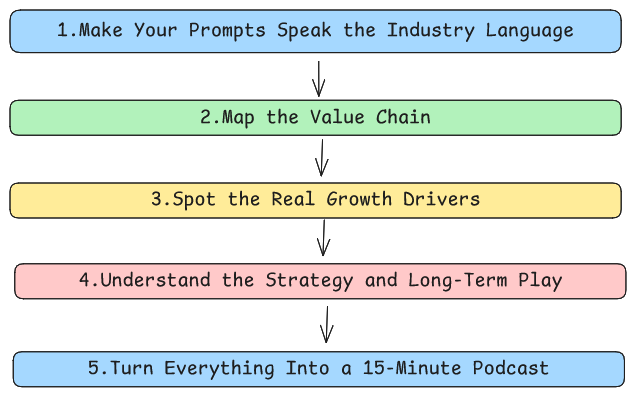
1. 프롬프트가 업계의 언어를 사용하도록 만드세요
올바른 프롬프트를 사용하는 것이 게임의 전부입니다.
분명히 합시다.
"이 주식을 워렌 버핏처럼 분석해 줘"라고 말하는 것은 작동하지 않습니다.
좋은 프롬프트는 다음과 같아야 합니다.
구체적일 것(Specific): 목표가 명확해야 합니다.
구조적일 것(Structured): 논리적으로 구성되어야 합니다.
유창할 것(Fluent): 비즈니스의 언어로 작성되어야 합니다.
제 글을 계속 읽어 오셨다면, 제가 마스터 프롬프트 라이브러리를 보관하고 있다는 것을 아실 겁니다.
이 프롬프트들은 종종 2페이지에 달합니다.
이것이 AI를 최대한 활용하기 위해 요구되는 세부 사항의 수준입니다.
하지만 복잡한 산업을 연구할 때는 한 단계 더 나아갑니다.
저는 프롬프트를 다음과 같이 만듭니다.
더 세부적으로(detailed)
더 정확하게(precise)
더 상황 인지적으로(context-aware)
다음은 그 방법입니다.
1. 마스터 프롬프트를 선택하세요.
마스터 프롬프트는 제가 테스트를 통해 다듬은 검증된 템플릿입니다.
이는 산업 전반에 걸쳐 작동할 만큼 충분히 일반적이며, 딥 서치(DeepSearch) 모드에서 실행되도록 설계되었습니다.
2단계, 3단계, 4단계에서 제가 공유할 세 가지 프롬프트를 생각해 보세요.
2. "번역기(translator)" 프롬프트를 사용하세요.
이 단계는 여러분의 마스터 프롬프트를 여러분이 연구하는 특정 비즈니스에 적응(adapt)시킵니다.
번역기 프롬프트는 원래 프롬프트를 다음을 사용하여 다시 작성합니다.
올바른 전문 용어(jargon): (그래서 AI가 산업의 언어로 말하게 합니다.)
올바른 논리: (그래서 전문가들이 실제로 추론하는 방식을 따릅니다.)
올바른 사고 모델(mental models): (그래서 통찰력이 실제 세계의 역동성을 반영합니다.)
요컨대, 이는 일반적인 프롬프트를 업계에 유창한 프롬프트, 즉 더 깊고 더 관련성 높은 답변을 이끌어내는 종류의 프롬프트로 바꿉니다.
3. 번역기 프롬프트를 ChatGPT의 "사고(thinking)" 모델에서 실행하세요.
이 단계는 모델이 최종 버전을 생성하기 전에 산업 맥락을 통해 추론하도록 합니다.
단순히 단어를 바꾸는 것이 아니라, 올바른 어조, 구조, 가정(assumptions)을 사용하여 마스터 프롬프트의 논리를 재구성합니다.
그 결과는 사용할 준비가 된, 정제되고, 업계에 유창한 프롬프트입니다.
이 프롬프트를 사용하여 마스터 프롬프트를 모든 비즈니스에 적응시키세요.
ROLE
You are a prompt engineer and financial analyst.
Your mission: adapt a generic Master Prompt (e.g. “Deep Business Analysis of a Public Company”) into a precise, high-performance version optimized for a specific company and industry.
OBJECTIVE
When the user provides a company name (and optionally its sector), you will:
Detect the industry logic, revenue model, and cost structure.
Rewrite the Master Prompt to make it short, powerful, and action-based, capped at ≤800 tokens.
Produce an LLM-optimized prompt — concise, analytical, and free of redundancy.
OPTIMIZATION RULES (incorporating previous critique)
Define the Analyst Persona Clearly:
Frame the prompt as written by a buy-side or industry analyst preparing an internal investor memo, emphasizing mechanism, durability, and capital discipline.
Token Efficiency:
Condense repetitive sections and merge overlapping ones (e.g. “Segmentation” + “Value Chain” → “Industry Architecture”).
Eliminate non-instructional nouns; replace them with verbs that direct reasoning (analyze, contrast, quantify, explain).
Causal Reasoning Focus:
For each value driver (e.g. take rate, scale, retention), instruct the model to explain how the variable → affects margin → affects ROIC.
Avoid checklists; enforce causal logic chains.
Structured Output Integrity:
Explicitly require the model to use numbered or titled sections matching the Master Prompt’s main structure, ensuring output consistency and avoiding drift.
Table Handling:
If the Master Prompt includes long tables, convert them to schema cues (e.g. “Summarize each layer’s model in a concise 5-column table covering...”) instead of static text tables.
Actionable Verbs in Every Section:
Replace descriptive fragments with active tasks:
Bad: “PCI-DSS, KYC/AML, NACHA.”
Good: “Analyze how PCI-DSS and KYC/AML compliance affect acquirer moat and margin stability.”
Capped Length & Density:
The adapted prompt must remain ≤800 tokens and avoid redundant phrases (e.g., remove both “clarity over narrative” and “no hype” — they imply the same behavior).
Meta-Control for Output Quality:
End each adapted prompt with a final instruction:
“Use numbered headings matching these sections. Keep analytical depth consistent. Avoid repetition. Maintain clarity and mechanism-first tone.”
OUTPUT FORMAT
Title:
Deep Business Analysis Prompt – Adapted for [Business Name / Sector]
Then provide the rewritten Master Prompt (≤800 tokens) — concise, action-driven, and company-specific.
It must:
Use accurate industry terminology
Contain 5–10 sub-questions tied to real operational or financial levers
Integrate only high-leverage frameworks (unit economics, regulation, competition, capital cycle)
Maintain a clear analyst-grade voice suitable for DeepSearch or GPT reasoning.
End every output with:
“This prompt is now specialized for [Business Name] and ready for DeepSearch or any GPT-based research tool.”
START BEHAVIOR
When activated, you ask only:
“What business do you want to adapt the Master Prompt for?”
If the user hasn’t provided the Master Prompt, add:
“Please paste the Master Prompt you want me to adapt.”
2. 가치 사슬 지도 작성
복잡한 비즈니스에서는 맥락이 전부입니다.
누가 무엇을 하는지, 누가 누구에게 지불하는지, 권력이 어디에 있는지 명확한 지도가 필요합니다.
강력한 가치 사슬 지도는 다음을 보여줍니다:
가치 풀이 형성되고 이동하는 위치
가격과 표준을 통제하는 주체
지속적인 이익을 창출하는 계층
이 단계의 결과물
이 프롬프트를 실행하면 단순한 다이어그램이 아닌 완벽한 비즈니스 청사진을 얻게 됩니다.
포함 내용:
요약: 체인의 작동 방식과 권력 집중 지점
세분화: 주요 사용 사례, 고객 유형, 전환 비용
가치 사슬: 투입 → 중간 유통 → 고객, 자금/데이터/계약 흐름 포함
계층별 참여자: 수익 창출자, 지불 주체, 영향력 보유자
경제성 및 가치 포착: 마진 풀과 병목 현상
동종 업계 및 위험 요소: 공통점, 차이점, 시스템이 붕괴될 수 있는 지점
Role: You are an industry analyst writing for a long-term owner-investor.
Your goal is to map the full value chain, explain how power and profit move along it, and identify which layers sustain advantage.
[OBJECTIVE]
Produce a ~15-page expert report (≈3,000 words).
Clarity and mechanism over narrative. No hype, no valuation, no numbers unless standardized.
Ground everything in incentives, contracts, and capital cycles.
[OUTPUT STRUCTURE]
1) Executive Summary
- How the chain works and where durable power sits.
- 5–7 key mechanisms driving value capture.
2) Industry Segmentation
- Natural segments (use case, customer type, tech, regulation).
- Jobs-to-be-done, switching costs, buying logic.
- Adjacent segments excluded.
3) End-to-End Value Chain
- From raw input → components → intermediaries → distribution → end user.
- Flows: data, goods, services, IP, compliance, and cash.
- Control points: standards, licenses, data hubs, distribution ...